Thursday, July 30, 2015

Don't Tell Me What I Can and Can't Do, I Can Change the World...


As President Obama touched down in Kenya early on Friday July 24, 2015 Carmella Tal Tomey, Assistant Research Professor at the University of Michigan School of Public Health, had only recently returned from Nairobi herself. Ella studies complex links between age, place, social and psychological factors, and physical impairment. She has recently expanded from research into what makes for healthy communities here in the U.S. to work within scientific communities overseas. She is developing video and slide materials to complement intimate, face to face workshops where she enables U.S. students and younger scholars to train with their international counterparts for more focused and effective writing, more responsible conduct of research, and more collaborative and productive careers. 


Our interview with co-hosts Jennifer Johnson and Sam Molnar was peppered with upbeat recent Kenyan dance tracks (playlist here), and great stories of her adventures there with colleagues and friends. We honed in on Ella’s collaboration with Professor Jesse Njoka, who directs the Center for Sustainable Dryland Ecosystems and Societies (CSDES) at the University of Nairobi (UoN). Other UoN faculty Judith S. Mbau and Stephen Merithi collaborated with Ella to facilitate the workshop. They are pictured here in a peer review writing exercise they plan to continue using within their own curricula and communities.


UM will host a “Metaworkshop” with African colleagues from Gabon, Kenya, and Ethiopia in October under the auspices of UM’s STEM-Africa initiative (Science, Technology, Environment/Engineering and Medicine/Math), African Studies Center and International Institute, and with support from colleagues at UCLA and Tulane working on a National Science Foundation PIRE grant in equatorial Africa. The meeting will review models for academic bridge building that can offer a next generation of scholars in sustainability and global health fields more integrative and collaborative training from early in their careers.

Previous Afro-optimist broadcasts on our show abound and the playlists range unapologetically across regions and eras. Our STEM Africa Partnerships broadcast starts with complex polyphonic pipe orchestras from Central African Republic, reflecting on the intricacies of African indigenous knowledge and practice. Then it takes us through Gil Scott Heron’s angry “Whitey on the Moon” poem set to rhythm, reflecting on asymmetric access to science within racist U.S. systems. It ends with Naeto MC singing “Things are Not the same…Ten over Ten” announcing positive change from his platform as the Nigerian “only MC with an MSc.”

In terms of talk, that hour we quote from the vision of STEM Africa leaders here on campus, Mechanical Engineer Elijah Kannety Asibu and Mathematician Nkem Nkumba who have engaged African scientists working internationally in considering scientific needs and strengths on the African continent. We also hear from Dr. Heather Eves, founding Director of the Bushmeat Crisis Task Force, who has taught in higher ed settings from the DC metro area to the Caribbean, and mentored many conservation professionals from Cameroon to Kenya. Heather’s persistent constructive engagement parallels the care Ella Tomey takes with her curricular materials. Dr. Eves also address radio as a tool for scientific and policy awareness and debate in African settings, and creative writing as a vehicle for better connections among and between scholars from varied disciplines and the wider publics they seek to engage.


Another Afro-optimist broadcast from 2011 tackled the Africa-Asia Nexus, with a mix of Indian and African music. A lively discussion blazed in studio between Anthropologist Omolade Adunbi about his work on oil extraction where his family and friends live and work in the Niger Delta, Geographer Dr. Bilal Butt working in his native Kenya on pastoralism in national parks, and the School of Information’s Dr. Joyojeet Pal who hails from Mumbai but has worked on installing high speed wifi cables in rural Rwanda, and studying uptake of laptop technology in rural primary schools in India. You think you know the globalized green academy? Think again…


…and again. Just last year, Dr. Pete Larson led us on an audio tour of really heavy metal African rock, while talking about his own metal band and his research on malaria in Kenya. Hot indeed!  We updated that broadcast with this week's where we played more dance tunes from the techno and hip scenes in contemporary Nairobi, including artists like Just a Band and Wangechi, who is, according to recent interviews, completing university level studies in economics so who knows, maybe one day we can workshop with her too!


These days Pete Larson can be found blogging in English about the interfaces of epidemiology, development and culture, and teaching in Japanese as an Assistant Professor at University of Nagasaki, based in their Institute of Tropical Medicine Kenya Field Station. Pete also holds down an Adjunct Professor position right here at the UM’s School of Natural Resources and Environment, mentoring UM masters students like Mike Burbidge, pictured below. Mike and others are seeking better field understandings of pastoralism, wildlife management, and spatial and social aspects of zoonotic disease transmission. They live with families and work with Kenyan field research teams, as pictured below where Pete Larson and Mike Burbidge celebrate eid, the end of the Ramadan period, with neighbors and hosts in Kwale, Kenya.


Pete figured in today’s interview with Ella--especially in her tales of Nairobi nightlife, to which she was introduced right off the plane!  Unlike President Obama, Pete and the Michigan Difference team did not have a heavily armored and defended vehicle. But they did and do make a lot of impact on the lives of students and teachers at UoN (Nairobi), UN (Nagasaki), and UM (that’s right, Michigan). Welcome to the future. The revolution will not be televised. But if Ella Tal Tomey has her way, it will be collaboratively thought out, and carefully written about. Go Blue!


Sunday, July 12, 2015

Of Rock and Roll and Revolutions

What timing, on the day the Confederate Flag was at last lowered from the South Carolina State House, we gathered in the studios of WCBN FM Ann Arbor for a broadcast on flags, festivals, and facing change in our nation. 

This photo depicts UM Prof of Music, Theater and Dance Mark Clague, whose work on the history of U.S. patriotic music can be found on his Star Spangled Music website. Here he is eyes closed, listening hard to one of several versions of Jimi Hendrix playing The Star Spangled Banner (or, as he puts it, singing with a guitar...) as UM undergrad student David Clive hosts the show. 


From Sharon Jones singing this land is MY land, to Hendrix's many versions of our national anthem, and finally Barack rocking Amazing Grace, we unpack on mike how symbols and melodies mean so many things to so many Americans. In the expert hand of Hot in Here founder Jennifer Johnson, we get our signature mix of scintillating talk and stone cold grooves for summer's hottest days. 


Listen in on the archive section of our web page to hear more about how music helps mark moments we we can, together, pivot and head in new historical directions...as Clague notes "history is more about the future than it is about the past." Do you agree? comment below, or at www.hotinhere.us.

Sunday, May 31, 2015

Let's start...a summer radio show

Summer is starting, and as the waves of teaching work recede, the Blogging can begin again. A summer blog? Slog? No, that sounds too wearying for the way this writing pulls thoughts out to play.

And, of course, given how much i have learned from Central African Republic (but also from Ireland), there is also the primordial importance of the spoken word.

So i'm proud to announce that the people i love to talk and listen with most these days, the production team of It's Hot in Here on WCBNFM Ann Arbor, are joining me in broadcasting every Friday at noon throughout the summer, for the first time since the show's inception in 2008.


And, yes, we'll also keep posting our blogcast archive over the weekend after the live show, giving you more links, videos, bios, and background on the issues discussed.

We're also working this summer to make the show easier for you to subscribe to as a podcast, or write into with your comments and suggestions of themes. Because we are broadcasting from the FM studio like a bunch of DJs, we won't always be able to air your calls like we often do from the Production A studio with its engineering booth.

Still, we want to hear from you! We want to thank our listeners for tuning in, for calling in, for keeping things hot. One of our founders, Jennifer Johnson, will be back in the studio this summer!

Check out our first show from Friday of Memorial Day weekend here.  And check back on that same site soon for the upcoming blogcast from last Friday's show on Food Sovereignty, which got some of the most exciting and excited calls we've had in a while.

Thank you Ann Arbor, Ypsilanti, and the World.

Happy Summer!


Thursday, July 31, 2014

Of Rainbows and Revolutions

Listening to the fireworks of summer independence day festivities always makes me glad not to be hearing gunfire. It also stands as a reminder of the work we are all still doing to live together free of fear. 


On Sunday July 27, 2008, Jim David Adkisson walked into Knoxville’s Tennessee Valley Unitarian Universalist Church and opened fire on the congregation as they were watching the youth program perform a musical. Two adults died, and seven people were seriously injured trying to protect the children. One of my best friends from high school shattered both kneecaps falling to the floor to shield her two young daughters from the bullets.


Above, the TVUUC church that was built in the shape of a Chalice, which is the symbol of the Unitarian Universalist faith. It was also a good shape to save an ancient tree that was growing on the building site, and whose leaves can be seen above the top of the building (accessed 7/1/13  at www.tvuuc.org).

Adkisson’s shooting spree in Knoxville that hot summer morning was “politically motivated” according to the investigations following the violence, as reported by local media (and wikipedia). A veteran of the U.S. Army, his very vocal hatred of "Democrats," "African Americans," and "Homosexuals" fueled his opposition to TVUUC. Testimonials from those who were in the church at the time of the shooting reflect on why it is a risk and a privilege—apparently one even worth dying for--to be a congregation that welcomes all spiritual beliefs, races and sexualities in today's U.S.:                                                                                                                 
     ...There has been some speculation as to why the shooter did it. Some speculate mental      illness--and anyone who would do something like this has to be at least a bit mentally          ill--but some point out that we may have been targeted because we are a welcoming          congregation…I will say, though, that we'd not long ago put up a banner announcing          the fact that everyone is welcome in our church, regardless of race or sexuality. If this          shooting was politically motivated, well... it wouldn't be the first time we've dealt with          hatred because of our beliefs. Back in the fifties, before we had our own church                    building, many people refused to rent space to us because we had a mixed-race      
     congregation. We're not afraid to do the right thing, and, even after these events, we will      still be unafraid. We are a loving and welcoming congregation, and we are strong.       
     Thanks again to all those who are keeping us in their thoughts and prayers      
     (http://salvador-dalai.livejournal.com/4220.html). 

One congregant looks back on the bravery that limited the death toll to two. In those split seconds, many individuals, acting together, had the instinct to place themselves between Adkinsson and the others in the room:

…thank you to at least three heroes that I know of. Greg McKendry, one of the two who died, apparently blocked the first shot, saving who knows how many people. After the second shot, several members of the congregation charged the shooter. Among them were John Bohstedt, a history professor at UT, and... well, as a parent I know him as "*** Birdwell's father." There were others…the shooter had a lot of ammo. A lot. If he hadn't been stopped, even the 3 minute response time from the police wouldn't have averted an even greater tragedy.

Another victim of the TVUUC shootings, Tammy Sommers, spoke publicly about her trauma a few summers ago, in order to express solidarity with victims of a shooting in a Sikh temple in Wisconsin in August, 2012. She noted, with a wry sense of disbelief still lingering in her voice:  "He was entering the sanctuary when he opened fire…The toughest memory that I had was I bled on my children in a way a mother would never wanted to."[1] 
   
Today I am a member of a UU congregation that is bigger than the one I recall from East Tennessee, where the man "in the pulpit" (though most UUA congregations have soaring, spare modern rooms for meetings) was former UUA President John Beuhrens. John is a graduate of Harvard Divinity School and expert on biblical scripture. My childhood church was one of his first ministries, and he both learned and taught a LOT. He and his wife, an Episcopalian Minister, were beacons to all of us, demonstrating how dual careers of care in the world can work without depleting marriages and families. When he officiated at my wedding in the monument to social justice that is Timothy Dwight chapel on the Yale University campus he offered spare but grave advice to me and my husband: "Take Care of Each Other." In times of trouble, we cleave to that.

The Minister in my new church, First UUAA, did not study scripture for years to get there. As she tells it, she was working as a sorry-for-herself, snowplow-driving dyke in Maine when she found her calling. Later, she gained  wide acclaim for her first sermons, which obtained standing ovations around the country. She spoke with conviction, humor and honesty about her own journey from devouring anger as a marginalized American to a stance of active, transformative love and a generous ministry. 


My new church’s tree is a Downy Hawthorne, documented as the largest of its subspecies in the United States…possibly in all of North America. It stands behind the church on the large parcel of rural land the congregation bought to build on and have preserved as a network of trails and outdoor recreation or meditation sites. My daughter and I often walk out after church to sit under it and pray when we are worried for the health of grandparents, concerned for friends in places torn by contemporary political conflict, or just in need of guidance and peace in our own lives.  Hawthornes are sacred in much of Europe; they provide flowers for Mayday festivals and fertility rites of spring. They are Shakespeare's "fairy groves." I can see why, sitting out there of a Sunday in all seasons.

In front of the church, at the main entrance, flies the Rainbow Flag. My daughter learned this year in her Spiritual Growth class on Sunday mornings about the rainbow as a symbol of the covenant between God and Noah as the floods receded and the earth again became a hospitable place for human (and other species) habitation. She has also learned that the rainbow is our church covenant, as a welcoming and tolerant congregation that believes in embracing the complexity of social identities, of science, of collective action and individual moral stands against the floods of hatred, bigotry, and environmental harm, even in the face of armed anger. 


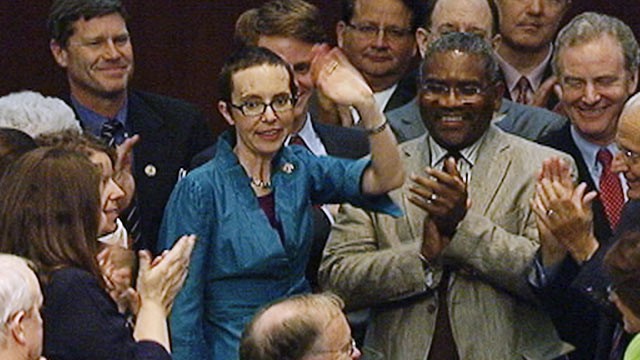
Places of worship aren't the only targets for armed anger; one thinks of Congresswoman Gabriel Giffords, attacked in a secular site--an Arizona supermarket. Her survival seemed so unlikely, after being shot through the brain by a disaffected and disoriented young man in the parking lot outside the store where she was meeting and greeting constituents in 2011.  Several victims in that shooting died, including a federal judge and a nine year old girl. This photo  depicts Giffords returning to the House Floor, nearly six months after the shooting, triumphant but terribly fragile. Today Gabby and her husband, former astronaut Mark Kelly, are organizing Americans for Responsible Solutions, a broad, non partisan call to action in the face of special interests that dominate gun control discourse about rising death tolls in the U.S. from gun violence.  

But in searching for news archives on the TVUUC story, I found instead articles about a wave of increased gun violence in Knoxville neighborhoods in recent summers, and seminars in the East Tennessee area on “how to survive workplace shootings” as professional training for employees of banks and other likely targets. During a lockdown on my University campus a few years ago, as people sat behind office doors, phones switched to silent, barely daring to breathe, i marveled at how that can be "freedom." 

Such concerns are not limited to college campuses; my daughter began learning tactics for such scenarios in elementary school. One day her after school report over snacks included the comment "I felt so bad for my friend; he thought the drill was real and wet his pants he was so scared." The principal later explained to me when I inquired that realism in such exercises is crucial to their success in preparing students to survive a shooting. Wow. 

Ok maybe if such drills had they been part of our every day church life in Knoxville, they'd have helped Greg McKendry or John Bohstedt in those seconds when they crudely and courageously gave their own lives to save others. All i know is, accepting these as reasonable risks is a glaring symptom of our inability to make social changes at more structural levels that reduce risk and fear in our lives as a society. 


On the 4th of July, U.S. citizens celebrate our country’s victory in a war for Independence. Some also get dressed up and drink a glass of wine or two on July 14 to celebrate France's revolutionaries who stormed the Bastille prison. What we are really celebrating is, at least in part, the distance we have traveled from those original gruesome struggles. Or have we? Back then the political stakes of power sharing seemed clear enough to motivate self sacrifice on a massive scale in the name of transformation. What passes for political motivation behind the violence in our public and sacred places today seems tragically out of step with collective mobilization for positive social change. It comes from mostly mentally ill, tragically alienated Americans. Many of them have been wronged by our society, or just have something that is wrong with them. Too often, they express that pain through murdering those who are living happily in dynamic, changing communities.  

Today's Knoxville TVUUC Minister Chris Buice helped his congregation heal from the shooting. The church moved from annual rituals of rememberance to marking the event once every ten years. TVUUC members consistently reach out to others who are victims of similar violence (such as the Sikh temple in Wisconsin, or the school in Newtown, Massachusetts, or that in Oregon a few years ago, or…). 
Buice notes that one of the hardest things to handle is the forceful hatred--of self and others--that animates the perpetrator. Survivor Tammy Sommers concurs: “It is important to stand on the side of love, peace, and kindness.” It is that simple. 

Many members of Unitarian Churches around the world found their way to it from a life of being bullied and derided as "geeks" or "freaks" or "queers" or "green radicals." They stand on the side of love because they know that asking hard questions about social norms, embracing social difference and protecting nonhuman lives on our planet has historically been punished with stonings, burnings, draggings, and--perhaps increasingly--shootings.  As the water protectors movement gains momentum in the U.S. and beyond, and the stakes in wildlife conservation get starker than ever, these are not just U.S. challenges. All around the world, wealth inequalities that worry us show no signs of abating. There is no clear single new Bastille for us to storm, no single Evil Empire against which to stand. That makes things complicated.


Nonetheless, let us rally: "Vive la Love." Let us not forget those who, unarmed, have bravely given their lives for this principle. Let us honor rather than denigrate those who show up for the marches, and churches, and rallies where they risk being targets for the violence that flows from angry fear of change. Just because some cannot trust diversity, complexity, and equitable representative political process to work for humanity's future does not mean that future is beyond our reach. Sure, we have not yet perfected the practice of these principles. But we owe it to those who brought us this far on that path to continue walking toward it, reaching for it even in the face of fear. 

As we celebrate historic political and social victories in summer’s heat each year, let it renew our vision of human connections in the face of retrenchment, fear, authoritarianism. We cannot be cowed by the "isolated incidents" of murderous anger our society refuses to term "terror." Despite very real fears of being shot for being tolerant and open, members of my childhood church stand on the side of love. For them it is no mere mantra. It is a memory, and a lived commitment that they know is fundamental to a peaceful and prosperous society. 

Wednesday, June 4, 2014

Get thee to the Peonies

Just a few days ago, my friend Stephanie Preston sent me the link to this recent and beautifully rendered piece of reporting about a secret corner of the Nichols Arboretum.

As I read it, I was sitting in a lounge chair under a Douglas Fir tree on the shores of  Hood Canal in Washington state. I was a guest in a very simple but stately resort called Alderbrook, built in the first decade of the twentieth century. It still has a sense of old world charm, despite being in the midst of a region that knew all too well the ravages of large scale logging operations. Today, the area radiates only peaceful repose. The loudest sounds are seaplanes occasionally arriving or departing; or the noise of an entire group of conservation experts, assembled by NOAA for a meeting on indicators of community well being in marine conservation areas, giving a collective "whoop" and throwing themselves simultaneously into the cold salty water after too long sitting in conference rooms.

Reading in that idyllic Pacific Northwestern setting about the harm to the Arb made me reflect on how different spots on this planet, at various scales, have their times for damage and their time to heal. I perused the comments that accompany the slideshow of Schoolgirl's Glen in Ann Arbor, smiling to myself. I love when my colleague, Bob Grese (pictured here) shares his outdoor literacy. One cold morning when another colleague and I found a small bird outside the Dana building that seemed injured, we brought it inside. Of course it escaped from us, fluttering through the corridors just outside the main administrative offices. We attempted ineffectually to trap it, squawking about like birds ourselves. Bob arrived and with quiet confidence secured the poor, confused creature. He gently placed it back where it belonged. You might say he mediates the surrounding environment for a lot of us, in small and large ways, suffusing that work with his own scholarly understandings of the art and science of landscape.

As Director of the Arboretum, Bob has been working for years toward healing the land in this corner where woods once opened in gentle slope down to a riverbank.  Studying the images online, arranged like a naturalist's notebook, I learned to recognize scars that would otherwise simply have struck me as "rocks" and "mud," (no, that is "pre-glaciation sediment" which, while of interest to geologists, should NOT be exposed under our feet!)

This morning, on a run in the arb with my collie Stella, the two of us briefly explored the mouth of School Girl's Glen. Sure enough, right at the base near a lush bend in the river (a heron lifted off as we were exploring) the former glen was traversed by drainpipes, and the breeze carried whiffs of human sewage. Above our heads we could hear the beeping sounds of trucks backing up and moving around in construction sites around the ever expanding (and excellent) hospital complex atop the hill.

Troubling, to think of the hospital infrastructure, which never seems able to grow quite fast enough to keep ahead of all of our cancers and cardiovascular disease, all of our diabetes and strokes. Ironically, many such illnesses might have been mitigated before reaching crisis proportions in our bodies and societies,  just by time spent moving through a place like the Arb. Certainly i never ran there, until cardiologists sternly admonished me to do so.

The healing benefits of such exercise seem to pertain, whether in the arb as it used to be (oh, to stroll with schoolmates of a morning, gathering wildlflowers to press in the afternoon) or as it is now (quick Stella, we're late for my next meeting, let's go!). But they are all the more urgently needed in the hurried, stressed out lives we lead these days.

Stella, usually so sure footed and nimble, stumbled repeatedly on the loose, round boulders so raw and exposed, as if they were angrily deterring us from clambering over a gaping, open wound.  We turned around to re-establish our running pace on the less damaged paths of the arboretum.

No, Schoolgirl's Glen is not the place it once was.  Still it offers surprisingly timeless scenes: two young men were out fishing together in the Huron River (oh, dear...effluent?), wading into the cool water that wet their shorts, bare-chested but for their vests. Two others sat on stumps under a blossoming tree, locks of sunlit hair falling over their foreheads as they gazed down at the ground, lost in emotional discussion. Yet another sat alone on a picnic table, stroking his strawberry blond beard and gazing out at the river's continued rush in this long, wet spring.  Several pairs of forty something women triathletes-in-training also ran by, their pace so much faster than mine as to be a bit embarrassing. And then, at last, Stella and I arrived at the peony beds, clustered like a glorious shawl around the shoulders of that ravaged part of the Arb's body.


From the entrance to the peony beds one can peer down into a ravine at what is left of School Girl's Glen, seeing the erosion in sharp relief. Then, upon pivoting, one's eyes fill with the ephemeral beauty of the spring peony peak: a rich spectacle for all those of us who don't have the time to collect and press wildflowers.
 

The field of peonies was strangely empty this morning, wildly fragrant with the notes of earth, citrus, and rose being exhaled respectively by the thousands of different varieties of peony blossoms. When we had come yesterday evening around 8:30 pm, hundreds of Ann Arborites were strolling through these beds. Some were dressed in medieval garb and gadding about as four star crossed couples for the final dress rehearsal of As You Like It, this year's Shakespear in the Arb offering.  Others were in contemporary dress and seemed to actually BE couples (but, then, all the world's a stage?), swooning amidst the blooms  for photos that would announce their imminent weddings. Larger groups sat on blankets and lawn chairs, breathing in the aromas and drinking in the visual abundance of so many blossoms, along with their actual picnic suppers.

Whatever else is happening, and despite disregard for the buffer zones it desperately needs, the Arb continues to heal both itself, and its community. Those of us who benefit from that should listen closely to the words, spoken in frustration by Le Beau to Orlando in the second scene of As You Like it.  Truer ones cannot be found for our ongoing dance withe the soil and stone, blooms, and roots that embrace us, and all the creatures around us:
Hereafter, in a better world than this,
I shall desire more love and knowledge of you.

Thursday, May 1, 2014

Gender, Diversity and Legality in African Extractivisms: Fish

Critiques of dominant sustainability discourses don't get much more gun-slinging than this TEDx talk by the dulcet, dimpled Jennifer Johnson (she even wore the cowboy boots):


Watching her TEDx talk reminded me anew of why I have been so lucky to teach and learn with Jennifer. When she was a Masters Student it thrilled me to see a sharp girl who spent summers in holiday cottages on our own Great Lakes come of intellectual age navigating the blighted cities and development dead ends of the rust belt where once Rosie the Riveter reigned. Now she is wading for real into the fray about African fisheries, offering a most unusual mix of outrage and optimism.

Watching her also reminded me why the TED form is so useful, as it interacts with the much more elaborate narratives many of us produce. It distills things down to a powerful story, but one that is enriched by much more complex thought and work. It is vernacular, and intricate, and compelling. For an audience, it brings things to life. For a scholar, it reminds us why we do the work.

I would be remiss not to also mention so many of the undergrad students from my "Culture, Adaptation and Environment" class, past and present. Great to see them captured on camera sitting in that audience for Jennifer's talk (shout out Max, training your own guns on timber certification's imperfections when it comes to the gleam in your guitars!)

Thanks TEDx team, i know how many long hours go into this work (to hear some of the minds behind it talk about putting that event together, tune to their show for It's Hot in Here).

And may I also commend this campus for fostering such vibrant out-of-the-classroom interfaces for grad and undergrad minds to connect and create? That, too, is the Michigan difference.

Wednesday, April 2, 2014

Wolf Hunt Revisited

As the data keep coming in from the wolf hunts in Michigan over the last few years i can't keep myself from updating this post.

The jury is STILL out on the way that hunt is going to play into wolf populations here, and how it will shape interactions between wolves and humans in the long run. You can read the incremental coverage of this long running debate in various outlets: There is a 2014 Huffington Post story, or Fritz Klug's report from early that same year, and a follow on from John Barnes's report that March. Barnes wrote as a Federal Judge had stopped the kill by reinstating wolf protection, and as opponents of the hunt were organizing themselves for another petition against the hunt, and succeed in getting it back on a ballot for November 2014. But citizen votes to keep wolves protected met almost instant opposition from others in the state. By February 2015 Michigan's DNR was appealing the re-listing of wolves as endangered species, noting that it left many farmers in Michigan's UP without recourse when wolves threatened their livelihood. By July of 2015 a judge had upheld the Legislature's approval of the Scientific Fish and Wildlife Conservation Act, giving the NRC the ability to designate animals as game species. Later that same year, however, Michigan's U.S.  Senators issued a call to action for wolf conservation on Isle Royale.  Fast forward one year, to spring 20-16, and  some of the first extensive ecological surveys of wolf populations in Michigan were underway, even as members of the US Congress and Senate considered measures to permanently resolve the question by delisting wolves as protected species in Michigan and three other states where these debates rage. As they say, "it's complicated."

If you are interested in teaching or learning about these questions, create an account and check out our new Wolf Wars case along with others for classroom or community use. It is open access, a manageable module, and really well built. It is a new way my colleagues at Michigan are bringing together ecology with culture, politics, and economics to try to help those younger than we are do better job than we have at making "complicated" decisions.

This is not an issue that is going to be easily resolved, neither in Michigan, nor more broadly. This year's entering class of masters students at SNRE again sat with the dilemma of whether to open a wolf hunt in Michigan, during their orientation up at the Biostation; some had to play the role of hunters, others of scientists, others of animal advocates. It was uncomfortable. Wolves always make people uncomfortable.

In my last entry on this issue I offered you clips from the film Twilight. But the lone wolf in the animated tour de force "Fantastic Mr. Fox" reminds us  in a different way of the wolf's utterly unique symbolic weight in most cultures (and popular cultures). The scene reminds us to consider that hunting wolves is not necessarily anathema to respecting their animality. And protecting them doesn't always mean letting them remain free. Do those on both sides of the wolf debate in Michigan share the kind of respect-tinged-with-fear that Mr. Fox, with all his talking,  finally shuts up and just feels?

Here is Jason Schwarzman's account of how that scene got made (he voices the role of Ash Fox):

Well, okay. I’m just gonna say it. There’s a scene at the end of the movie when George Clooney’s character, myself, my cousin and the opossum, Kylie, are all on a little motorcycle driving back to our home... And we stop and we see a wolf on a distant hill... a beautiful moment between these foxes and little animals and this really like mysterious wolf who we’ve heard about the entire movie and who doesn’t talk in this scene and he’s not wearing clothes. He’s kind of, he represents I guess, the wild. ...they have this great connection, and in that moment, it really like to me the point of that scene is let’s keep on being free. Let’s keep on being animals. And it’s such an uplifting moment. When I’ve seen it with audiences, a bunch of people break into huge cheers and hooting. It’s such an awesome, awesome scene. It really just blows my mind.


 (videoclip from youtube; text from http://cussyeahfantasticmrfox.tumblr.com/)

And actually...we did the movie basically live together as a cast. We didn’t do the scenes, none of us really did it separately in recording booths, which is how typical animated movies are done. This one, Wes Andersen had us literally go and move onto a farm together and we all lived together. And we’d wake up in the morning, have breakfast and then if there was a scene, for instance, that took place underneath a tree, George Clooney and Bill Murray, everyone, would walk over to the tree that we’d find, we’d take our scripts out and we’d just start acting out the scenes. And it was basically like doing a movie just with no cameras. So there were actors, the director, Wes, and a sound man. And we were running around, growling and hooting and hollering, and if we had to eat a bunch of food like in the movie we always are eating like French toast or biscuits, we would literally be eating French toast and biscuits...

Anyways, one day when we were doing this particular scene with this wolf...Wes said, you know we should really get someone to play the wolf so that the guys have someone to act opposite. And we looked around and Bill Murray was standing there with his hands in his pockets. He took his hands out and said, “I can be the wolf.” And Bill Murray just took off running, or I guess trotting. And he ran, ran, ran, ran really far away until he was tiny. And he turned around and actually became the wolf, like he, it’s almost as if he embodied the wolf. And he acted it out for us, and it was so inspiring and so beautiful. And Wes actually took out his camera phone, filmed it, and then sent that footage to the animators to base the wolf off of Bill Murray, so Bill Murray is the uncredited wolf in this movie. And he...was so good, it was as if he practiced it. I mean, it was incredible, his wolf performance...


Jason's comments reveal a lot of important ironies (they are also incidentally, a tribute to the ways that actual ensemble acting can enhance the high tech feature films of the computer animation generation). I digress.

The naive but earnest engagement with "literally" going and moving onto a farm together, and having breakfast, and being under a tree, is striking to any of us who have ever or whose friends have ever farmed for real. Certainly the film set farm is a far cry from the Michigan livestock operations where lots of folks seek the right to shoot wolves. Yet it does suggest that there can be a place for the wild in the new landscapes humans are crafting to meet our food and energy needs and our seemingly limitless aspirations for residential domination of the natural world. Maybe that new "wild" won't be a place or system  that works like it used to (on my after dark dog walks around the Huron riverbanks my collie and i keep meeting bedraggled, exhausted foxes and coyotes...they seem to be uprooted; fleeing sewage spills, luxury home building and new road grading they only seem able to look at us plaintively for a moment, then flee).

Whatever wild will accompany our new "Food Water Energy" matrix world with open floor plans and pleasant recreational spaces, it will have to somehow justify how it enhances that world for us humans, and perhaps also our imaginations? The wild is icon, beacon, emblem for the various struggles we face as humans. It thus remains a crucial resource and one that more and more different kinds of people seek--if more and more through film and other digital media, and less and less through getting out there to hunt or fish or hike. Many only experience "the wild" through the kind of brief immersive experience that some shoot, or retreat, or reunion has afforded. Yet it stays with us, unforgettable, shaping all of the days we spend not doing that wild thing.  And maybe, on some of those days, we weigh in with a vote, or a "like" or a meeting, or a conversation, as the policy wheels turn on what to do and not do to wolves in our own backyards.